
 Hola

 Primera División // Jorn. 14


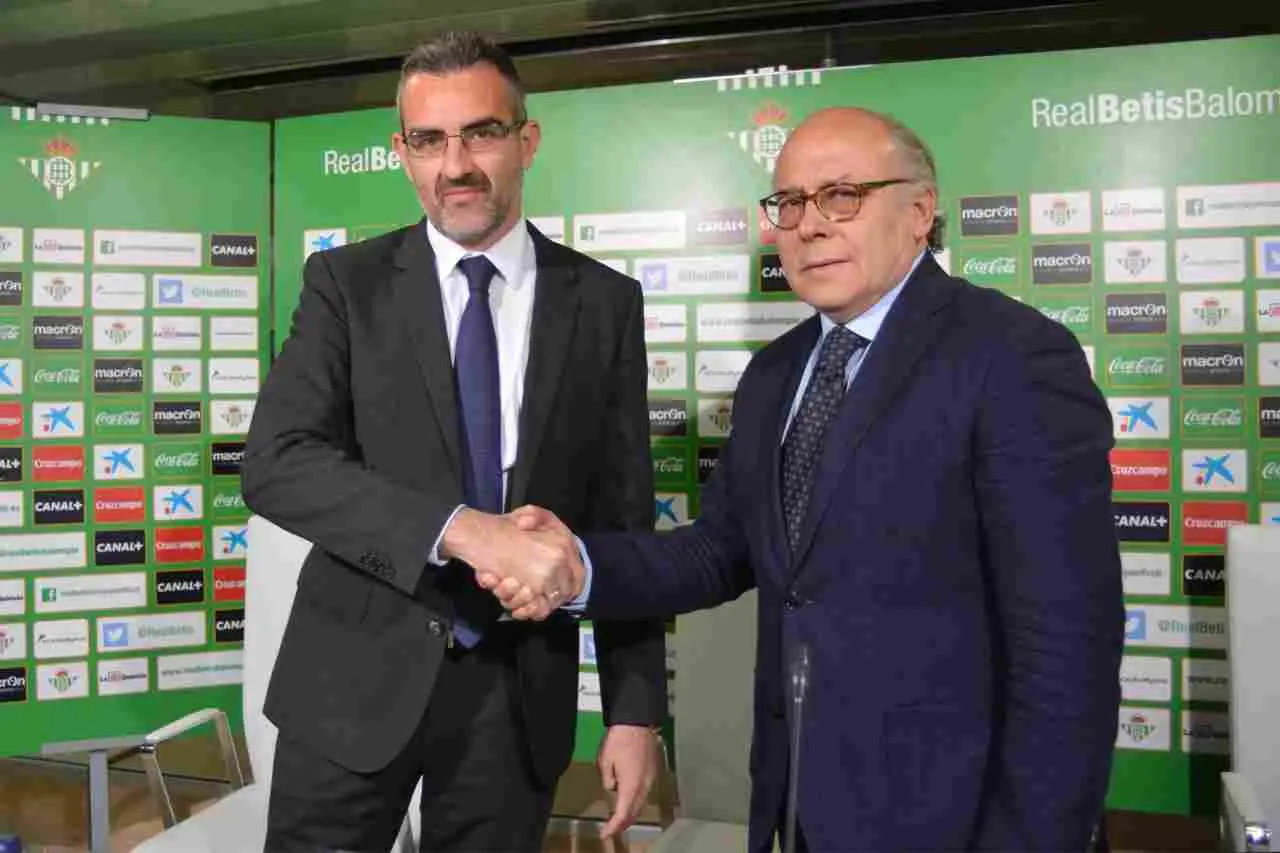
Macià on Mel: “We will work together for Betis’ sake”
The Technical Director explained that he “can’t think of other way of working with the manager”
Eduardo Macià finished his presentation as new technical director analysing different issues.
The role of Pepe Mel in players’ signing: “I can’t think of other way of working with the manager. He is the one who is with the players day after day. It’s in my way working, to sit together around the same table. I don’t consider it any other way, the manager is part of the project. Pepe Mel has the same interest as I have, for Betis to win and to be well. We have to overcome the idea that the manager is an isolated person. Pepe Mel and Eduardo Macià will work together; both of us will have their saying. We will make the best decisions together to succeed in the challenges that we set, always considering the resources that we have at our disposal. Comments such as ‘The manager asked for this player’ and ‘the technical director brought this other player’ are useless. Scouting is what it’s seen on the pitch, the bench and the stands; and there is work behind that. Both Pepe Mel and Eduardo Macià are completely sure that they are going to work side by side for Betis’ sake; it is what he wants and what I want.”
Have you talked about next year?: “We’ve talked, Pepe has a long career in Betis and he knows what Betis should be. We agreed completely on that. We have the same idea of what Betis would become. Once the moment comes, it will have a name. We agree from the beginning, which is of the utmost importance and which usually fails. Mistakes are usually made when you are not on the same page from the beginning.”
Betis has sold few players in the previous years: “The secret for selling a player is the moment when you buy him. When you purchase, you know whether you can sell or not. You shouldn’t get fooled when purchasing a player. You are aware that you are not going to sell a player when he is 29 or 30 years old when you pay for him; instead you are looking for his assets, personality and stability. If I’m searching for a 21-22 year-old player, I’m getting a player with sale potential. Then, the sale price will be determined by the club status. A player’s market price it’s not only set by the player himself, but where he plays. Is difficult for Betis to sell when the Club is in Second Division. The sale begins in the moment of the purchase. The sport aspect is crucial, if you buy waiting for assets or for growing assets.”
Joaquín: “He is performing spectacularly in ACF Fiorentina. It’s a shame that the Joaquín that we are seeing now wasn’t the same when he was 25, he would have played a hundred matches with Spain National team. He is quite involved with the project at ACF Fiorentina. We haven’t talked to him because the arrival of important players should be when the Club is ready. It’s a work that needs to be done to bring such players.”
Club economic growth in the future: “It was one of the things I valued, the Club’s sport and economic potential. I don’t really care if the budget is higher or lower, but do my but doing my best with this budget. Betis will grow at economic level if we grow in the sport aspect. If we do things right, we’ll achieve more than other clubs with bigger budgets. It doesn’t really matter what is the budget at my disposal, we will make the most of it. If the budget is bigger, we’ll be allowed to take more risks. The margin of error is smaller with a lower budget. Consequently, our responsibility is bigger.”
Apart from Piccini, the whole squad has contract for the 2015-2016 season: “We are not focused on the players that may finish their contracts or the ones on loan. We are focused on the ones that are going to be part of the future of Betis. We have to think how we want to do that, whether we want 25 medium level players or 14 of a higher level. Whether we are looking for quality and personality or players who are professionals and ambitious and know how to cope with pressure. I spoke with Pepe Mel about if we prefer quality over quantity. If the squad is stable, we’ll need to add up some more. It’s crucial that we don’t make a mistake building the first group for the future. We’ll fail if we get this wrong.”
Sevilla FC achievements: “We have to know how Real Betis is as we want it, we have to be our own model. From there, do as best as we can. It’s not useful to compare ourselves to Sevilla FC, the fans think differently. I don’t want to compare with Sevilla FC, we have to build Betis. Monchi is a good friend of mine and he values his job. They follow their path and he does his job. Rivalry is one of the most beautiful things in football, but it’s just two matches in a year, there’s a lot more than that. We have to build our project and get as far as we can keeping that fascinating and wonderful rivalry.”
Loans: “It depends on our strategy, our economic resources and how it affects negatively our patrimony. If we bring a player on loan in the same position as Dani Ceballos, we are not working for the Club. If we can bring a player that makes us better and we can get him we have to consider it. We must look for balance and not for harm. If we bring a player on loan, he has to improve what we have got already. He shouldn’t be brought if not. We have to move within that balance. The economic resources will show us where we stand.”
Signing big names: “It all starts with stability. When you are able to bring big players is because the Club is ready. There are stages where we shouldn’t fail, like creating a patrimony, and that comes with young players. They must need top young players to help for a future stability. A sale can be helpful in a difficult economic situation. Taking a wrong step can also happen, but you work at ease when you know that you have created a patrimony to rely on. We have to prepare the club for the arrival of big players. For example, Mario Gomez arrived to ACF Fiorentina after finishing certain stages of his career, and in a moment when the club could afford signing him.”
Will the new signings adjust to the tactical setting?: “The player profile will be set by the model we choose. If you want to make some specific kind of football, you need the appropriate players for that style. If you are looking for ball possession, you need a manager that accepts that and players to carry out those ideas. If you have a manager that prefers a more direct style and you say to him to play with short passes, that’s our fault. There are some aspects that are defined by your own identity; it’s hard to cover all the facets.”